
Guide
WireGuard vs IKEv2 on iPhone: which VPN protocol should you use?
WireGuard and IKEv2 are the two most common VPN protocols on iOS, and FollowNet supports both. They are equally secure in practice; the difference is in speed, behaviour when you move between networks and how easily networks recognise them.
WireGuard in short
WireGuard is a modern protocol with a small, auditable codebase and current cryptography. It connects quickly, has low overhead and is usually the fastest option on stable home and office networks. Because its traffic has a recognisable pattern, some networks throttle or block it.
IKEv2 in short
IKEv2 is an established standard with native support in iOS. Its strength is mobility: when you walk from Wi‑Fi to LTE or ride through areas with patchy coverage, it resumes the tunnel smoothly. It is slightly heavier than WireGuard and can also be blocked by restrictive networks.
Speed
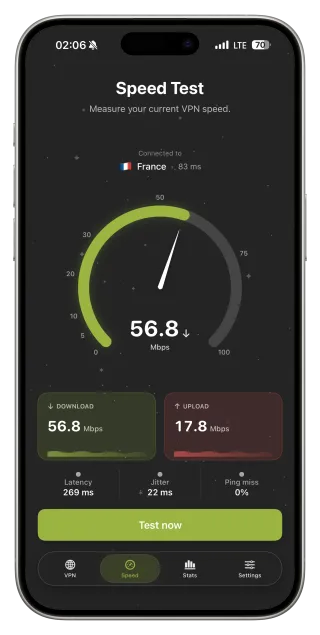
On a calm network WireGuard is typically a little faster and has lower latency. The difference is often small next to the effect of server distance. Measure it yourself: connect to the same server with each protocol and run Speed Test twice.
Switching networks
If you commute, travel or move around a lot, IKEv2’s reconnection behaviour is noticeable — fewer stalls when the phone hands over between networks. That is why FollowNet’s Travel profile uses IKEv2 by default.
When neither works
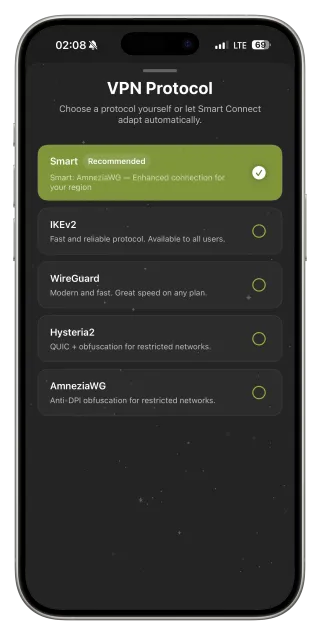
Some networks interfere with both. Then use Smart Connect: it falls back to AmneziaWG (a WireGuard variant with altered traffic patterns), Hysteria2 (over QUIC, good on lossy links) or VLESS Reality (looks like ordinary HTTPS). The Restricted profile keeps that ladder on by default.
Pick yours in two minutes
- Connect to a nearby server with WireGuard and run Speed Test.
- Switch to IKEv2 on the same server and run Speed Test again.
- If you mostly sit still, keep the faster one.
- If you move a lot, prefer IKEv2 or the Travel profile.
- If neither connects, return to Smart and let it fall back.
WireGuard vs IKEv2
| WireGuard | IKEv2 | |
|---|---|---|
| Speed on stable networks | Usually the fastest | Fast, slightly more overhead |
| Switching Wi‑Fi ↔ LTE | Good | Excellent, resumes smoothly |
| Connection time | Very quick | Quick |
| Blocked on restrictive networks | Sometimes | Sometimes |
| FollowNet profile | Public Wi‑Fi | Travel |
Key points
- Both are secure; the difference is speed and mobility
- WireGuard: fastest on stable networks
- IKEv2: best when switching between Wi‑Fi and LTE
- Smart Connect falls back to AmneziaWG, Hysteria2 or VLESS Reality
- Measure on your own network with Speed Test
FAQ
Which is more secure?
Both use strong modern cryptography when implemented correctly. Choose based on speed and mobility, not security.
Which uses less battery?
WireGuard is generally a little lighter, but the difference is small in daily use.
Can I let FollowNet choose?
Yes. Smart Connect picks the protocol for each network and switches if one fails.
Are both available on Free?
Protocol availability follows your plan in the app; the core protocols are available on Free within the weekly allowance.